About 4 minutes to read
An IEP meeting can feel like a meeting about your child that you happen to attend. The law says otherwise. Parents are full members of the team, and the meeting is where the numbers in this series begin: every placement, service and removal in district data was once a decision at a table like this one.
This post continues the series that began with Reading special education data from the bottom up. After who gets identified: reading disproportionality data, it takes up the IEP meeting itself, with questions families can bring. The full version is the atlas guide For families: questions to bring to an IEP meeting.
Your place at the table
IDEA names the parents as members of the IEP team (34 CFR 300.321). The school must tell you about the meeting early enough for you to attend, and schedule it at a time and place you both agree on. You can bring someone who knows your child, such as a relative, a friend, an advocate, or a staff member from your state’s Parent Training and Information Center. If you need an interpreter, the school must arrange one (34 CFR 300.322).
A few rights are worth knowing before you go:
- You can look at your child’s education records, without unnecessary delay and before any IEP meeting (34 CFR 300.613).
- If the school proposes or refuses a change, it must give you prior written notice explaining what it plans and why (34 CFR 300.503).
- If you disagree with the school’s evaluation, you can ask for an independent educational evaluation at public expense (34 CFR 300.502).
- The IEP must be reviewed at least once a year, and your child must be reevaluated at least every three years unless you and the school agree it is not needed (34 CFR 300.324, 300.303).
Before the meeting
- Can I see the draft IEP, evaluation reports and progress data a few days ahead?
- Who will be at the meeting, and what role does each person have?
- What does my child say about school? Could my child take part in all or part of the meeting?
- What do our district’s figures show? Look up your district in the IDEA Atlas and note one figure that raises a question, such as time in general classes or suspensions.
About goals
The Supreme Court has said an IEP must be reasonably calculated to help a child make progress appropriate in light of the child’s circumstances, and that the program must be “appropriately ambitious” (Endrew F. v. Douglas County School District, 2017).
- What will my child be able to do in a year that they cannot do now?
- How was each goal chosen, and how does it connect to grade-level work?
- How will progress be measured, and how often will I get a progress report?
- If my child did not meet last year’s goals, what will be different this year?
About services, setting and behavior
- What services will my child receive, how often, for how long, and from whom?
- What supports will help my child learn in the general class, and what has been tried?
- If my child will spend time outside the general class, what is that time for, and how will we know when it is no longer needed?
- Has my child been sent home early or removed from class this year? Removals count, even informal ones.
About life after school
Starting no later than the IEP in effect when your child turns 16, or younger if the team decides it is appropriate, the IEP must include measurable goals for life after high school and the transition services to reach them (34 CFR 300.320(b)). Some states start earlier.
- What does my child want to do after high school, and how did the team find out?
- Which courses, work experiences and community connections are in the plan?
Reading it from the bottom up
An IEP meeting can be run entirely by the book and still leave a family feeling like a visitor. Thomas Skrtic (2005) pointed to IEPs and IEP meetings as examples of how schools can meet the letter of the law through rituals that do not change practice. Kozleski and Thorius (2014) argue that schools improve when students and families help shape the work from the start.
Is this plan written for my child, or copied from a menu of standard services?
Afterwards, write down what was agreed and who will do what. A short email to the team summarizing the meeting gives everyone the same record. If you disagree with the IEP, the next post in this series explains the options.
Sources
- 34 CFR 300.300–300.324 (evaluations, IEP team, meetings, content of the IEP), 300.502–300.503 (independent evaluation, prior written notice), 300.613 (access to records).
- Endrew F. v. Douglas County School District RE-1, 137 S. Ct. 988 (2017).
- Kozleski, E. B., & Thorius, K. K. (Eds.). (2014). Ability, equity, and culture: Sustaining inclusive urban education reform. Teachers College Press.
- Skrtic, T. M. (2005). A political economy of learning disabilities. Learning Disability Quarterly, 28(2), 149–155.
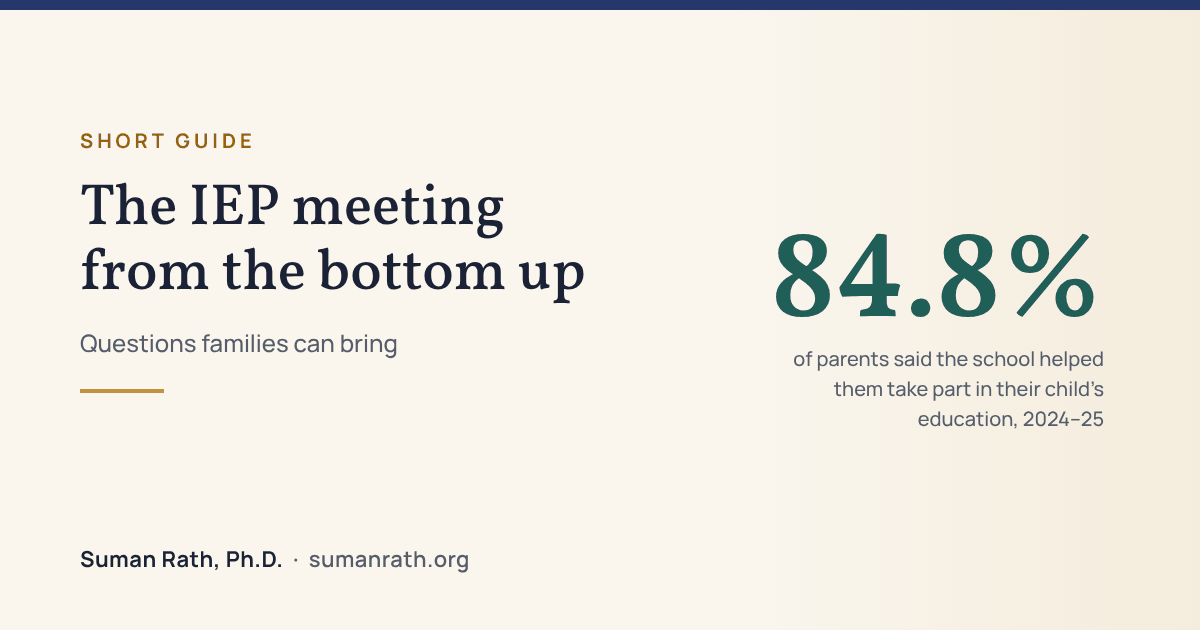
- Students served: U.S. Department of Education, Digest of Education Statistics, table 204.30; parent involvement: states’ IDEA Part B Annual Performance Reports, indicator 8, 2024–25, as compiled in the IDEA Atlas. Each state uses its own parent survey.
Comments
3 responses to “The IEP meeting from the bottom up: questions families can bring”
[…] The IEP meeting from the bottom up […]
[…] with where students with IEPs learn, discipline, who gets identified for special education, the IEP meeting, and dispute resolution. Each draws on scholars who shaped how I think about these questions, […]
[…] The IEP meeting from the bottom up […]