About 4 minutes to read
When a family and a school cannot agree, IDEA offers formal ways to settle it. Each state reports how often each one is used. Read from the bottom up, those counts are less a measure of conflict than a trace of what happened when the conversation at the IEP table broke down.
This post continues the series that began with Reading special education data from the bottom up. After the iep meeting from the bottom up, it takes up complaints, mediation and due process, and how to read your state’s counts. The full version is the atlas guide Complaints, mediation, and due process: what the numbers mean.
The options
Most disagreements are settled in conversation, at an IEP meeting or with a principal or special education director. When that does not work, IDEA provides formal routes.
| Option | Who decides | Federal timeline |
|---|---|---|
| State complaint | The state education agency investigates | A written decision within 60 days, with extensions only in limited cases (34 CFR 300.152) |
| Mediation | The family and school, with a neutral mediator | No set timeline; voluntary, free to the family, and any agreement is written and binding (34 CFR 300.506) |
| Due process complaint | A hearing officer, if the case reaches a hearing | A resolution meeting within 15 days, a 30-day resolution period, then a decision within 45 days (34 CFR 300.510, 300.515) |
A state complaint can be filed by anyone, not only a parent, about a violation of IDEA in the past year. It is often used when services in an IEP are not being delivered. Mediation is available at any time, is confidential, and the state pays for it. A due process complaint asks for a hearing about a child’s identification, evaluation, placement or free appropriate public education, and must be filed within two years unless the state sets a different limit (34 CFR 300.507). Most due process complaints never reach a hearing.
Reading your state’s counts
Each state page in the IDEA Atlas shows four counts from the federal dispute resolution data: signed written state complaints, mediation requests, due process complaints, and due process hearings fully held.
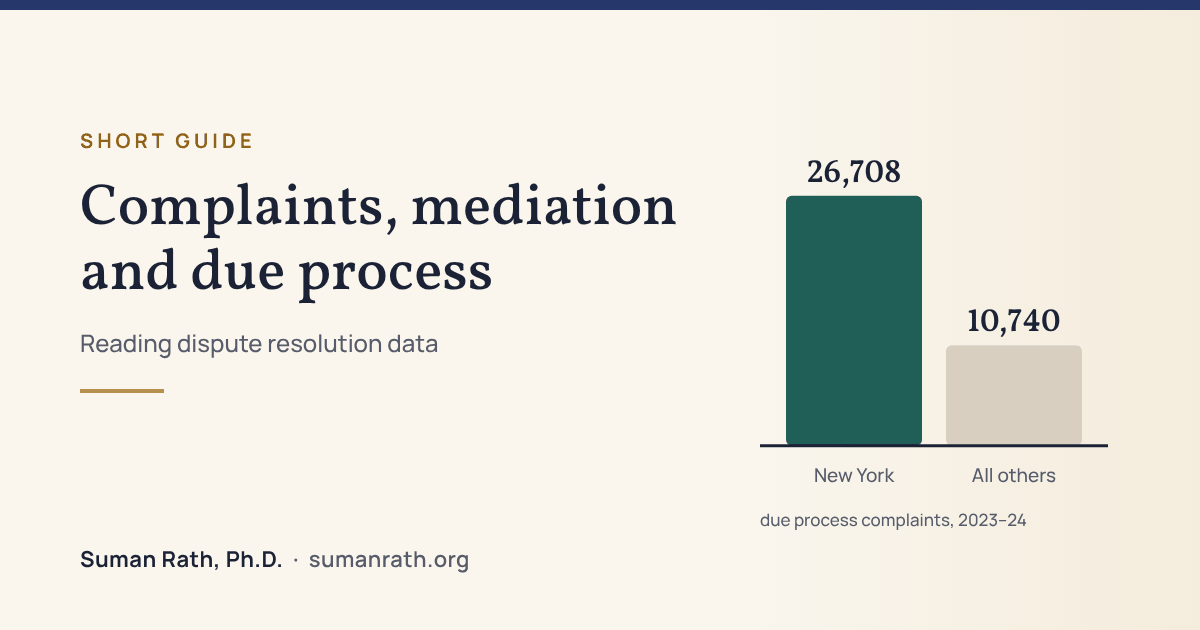
These counts are hard to compare across states. In 2023–24, New York accounted for 26,708 of the 37,448 due process complaints filed nationally, and 7,640 of the 8,117 hearings fully held. Large states have more disputes because they have more students. Some states settle more problems before a complaint is filed. A state with very few complaints may have few problems, or families who do not know how to file. Comparing a state with itself over time tells you more than ranking states.
Reading it from the bottom up
IDEA’s dispute options are rights, and families should know them. They are also a sign of what happens when collaboration breaks down. A due process hearing is a legal contest. It can fix one child’s program and leave the school’s way of working untouched.
Thomas Skrtic (1991) argued that schools serve students with disabilities best when staff work as collaborative problem-solvers, adjusting their practice together and with the people they serve. Kozleski and Thorius (2014) make the case for involving families in school improvement all along, before anything goes wrong.
What happens after a complaint is resolved? Does the school change anything for other students?
Questions to ask
- Before filing anything: have I asked, in writing, for an IEP meeting to discuss the concern?
- Would mediation let us keep working together while settling this one issue?
- Who in my state can help? Every state has at least one federally funded Parent Training and Information Center that helps families for free.
- Does the district track what disputes are about, and share what it learns?
This post closes the series for now. Each topic has a fuller guide in the IDEA Atlas, and every district page brings the numbers together for your own community.
Sources
- 34 CFR 300.151–300.153 (state complaints), 300.506 (mediation), 300.507–300.516 (due process, resolution, hearings, timelines).
- Kozleski, E. B., & Thorius, K. K. (Eds.). (2014). Ability, equity, and culture: Sustaining inclusive urban education reform. Teachers College Press.
- Skrtic, T. M. (1991). The special education paradox: Equity as the way to excellence. Harvard Educational Review, 61(2), 148–206.
- U.S. Department of Education, IDEA Part B Dispute Resolution data, 2023–24, as shown on IDEA Atlas state pages.